

MJ Insiders | Week of November 16, 2026
B.C. direct delivery is growing, Quebec has a bigger quarter and the Aurora story still needs an ending. Here is what the numbers mean for operators, without confusing a product announcement with a purchase order.
B.C. direct delivery is up 42% year over year. Good news. Now show us the freight bill.
The week of November 16 brings encouraging sales figures alongside some less convenient questions about margins, shelf space and store proximity. For cannabis businesses planning their next quarter, the useful work starts after the headline. Where did the growth happen? What did it cost? Is that policy change actually in force?
We have separated the commercial updates from the policy watch below. A proposed rule should not quietly become an operating assumption because somebody shortened it for a subject line.
Commercial updates
Direct delivery grows but the route still has to pay
Licensed B.C. retailers bought C$4.39 million through direct delivery in July–September, up 12.5% from the previous quarter and 42% year over year. Central wholesale remained much larger at C$156.4 million. The channel is growing, but those totals do not tell an individual producer whether its delivery route is profitable. B.C. wholesale report
For a craft grower, direct relationships can make room for a proper conversation about the product. They also take time. Before adding another stop, put freight, sales time and order frequency beside the revenue. A first order is useful. A repeat order that pays for the trip is considerably more useful.
More disposable products do not automatically mean more demand
Neobi counted 195 distinct disposable products on tracked B.C. menus in the week of January 5, 2026, rising to 280 in the week of November 9, 2026. Products are counted by barcode, not sales or units. Neobi tracks more B.C. stores now than in January, so the same-store comparison matters: across the same 310 stores, the average menu went from 19.9 to 28.9 disposables (+45%). Neobi
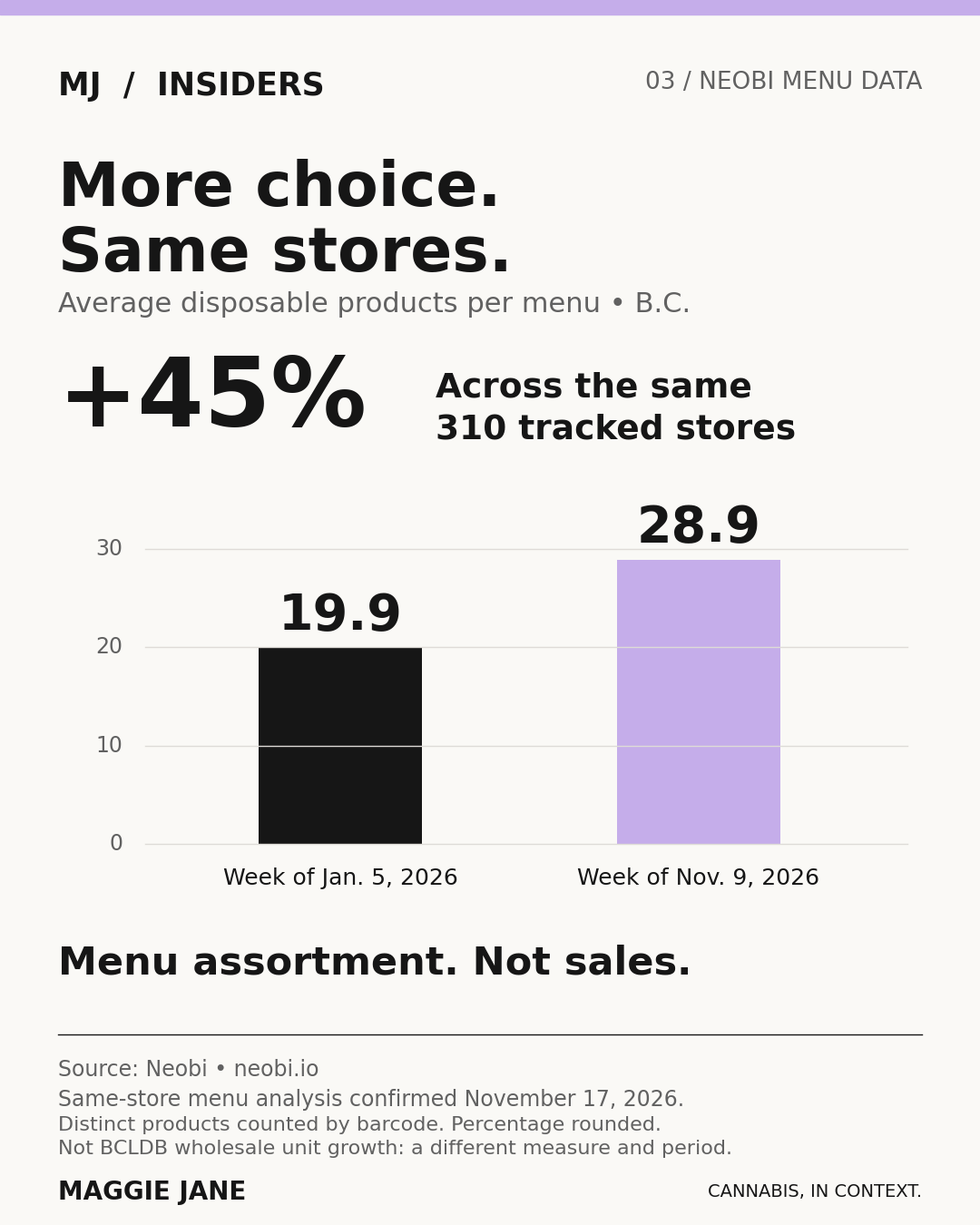
Separately, B.C. central wholesale data show disposable units up 45% year over year while cartridge units fell 1%. Neobi’s 45% same-store assortment increase and BCLDB’s 45% unit growth measure different things over different comparison periods. They are not matching results. Keep menu analysis and wholesale movement separate. B.C. wholesale report
For retailers, the next step is your own reorder report. More available products can mean more choice. It can also mean more cash sitting in a cabinet. Check what customers return for before expanding the assortment again.
Quebec has a bigger quarter and a changed comparison
SQDC sales reached C$207.5 million, compared with C$189.4 million a year earlier. Six additional stores, the introduction of vapes and changes to opening hours matter when interpreting that increase. This is not a same-store comparison. SQDC results
If Quebec is in your plan, revisit the current assortment and requirements rather than recycling last year’s pitch. More sales across a changed network do not prove that every category or store has improved equally. Start with the actual opportunity, then decide whether your product and support can meet it.
Producer results need more than one margin line
Village Farms reported cannabis exports up 75% to US$20.8 million while its Canadian cannabis gross margin moved from 55% to 48%, mainly on softer spot-trim pricing. Auxly reported net revenue up 24% to C$49.5 million and C$13.6 million in net income. Note the currencies before putting those figures beside one another. Village Farms · Auxly
For planning, give exports, domestic branded sales and bulk their own lines. Growth in one part of a business can sit beside pressure elsewhere. A blended forecast may look tidy, but tidy is not the same as useful when the team has to decide where to spend its time.
Aurora remains unresolved while Christina Lake stays independent
Organigram has a signed Aurora deal valued at about C$561 million. Curaleaf says its competing bid received competition clearances. Neither transaction has closed in the reporting covered here. Clearance and completion belong in different sentences for a reason. Organigram filing · Curaleaf filing
Separately, Christina Lake declined two unsolicited takeover proposals and said it would remain independent. These are different corporate situations, not one industry-wide instruction to change your account plan. Watch for confirmed changes in ownership or purchasing before assuming who will buy what next. Christina Lake
Product launches and genetics investment deserve a closer read
MediPharm reported Pocket Drops launches in Alberta and Ontario, plus a separate authorized cannabis extract-oil launch in Brazil. The Brazilian announcement concerns its own product and authorization; it should not be read as blanket market access for other products. MediPharm results · Brazil announcement
Rubicon announced a Squamish genetics facility supporting a library of more than 500 cultivars. That describes a genetics resource, not 500 products arriving on store shelves. Read announcements for what they establish, then verify current listings and availability before building a plan around them. Rubicon
Policy watch
The proposed one kilometre rule needs an existing store answer
Neobi found that about 200 of 387 tracked B.C. stores (52%) had at least one other tracked store within 1 km. In Vancouver city, a subset of the B.C. sample, it was nearly 9 in 10 (59 of 68). The sample covers stores with a menu in Neobi’s weekly data for the weeks of October 19 to November 9, 2026. Online-only listings, one duplicate record and two stores without a usable map location were removed. Neobi tracks 387 of BCLDB’s 536 stores, so these counts are a floor, not a census. Correcting locations can move the provincial count by one or two stores; one Vancouver store appears to be listed twice. Distance is straight-line distance between store locations, 1 km or less, checked against OpenStreetMap. It is not the legal measurement a final rule might use. Neobi
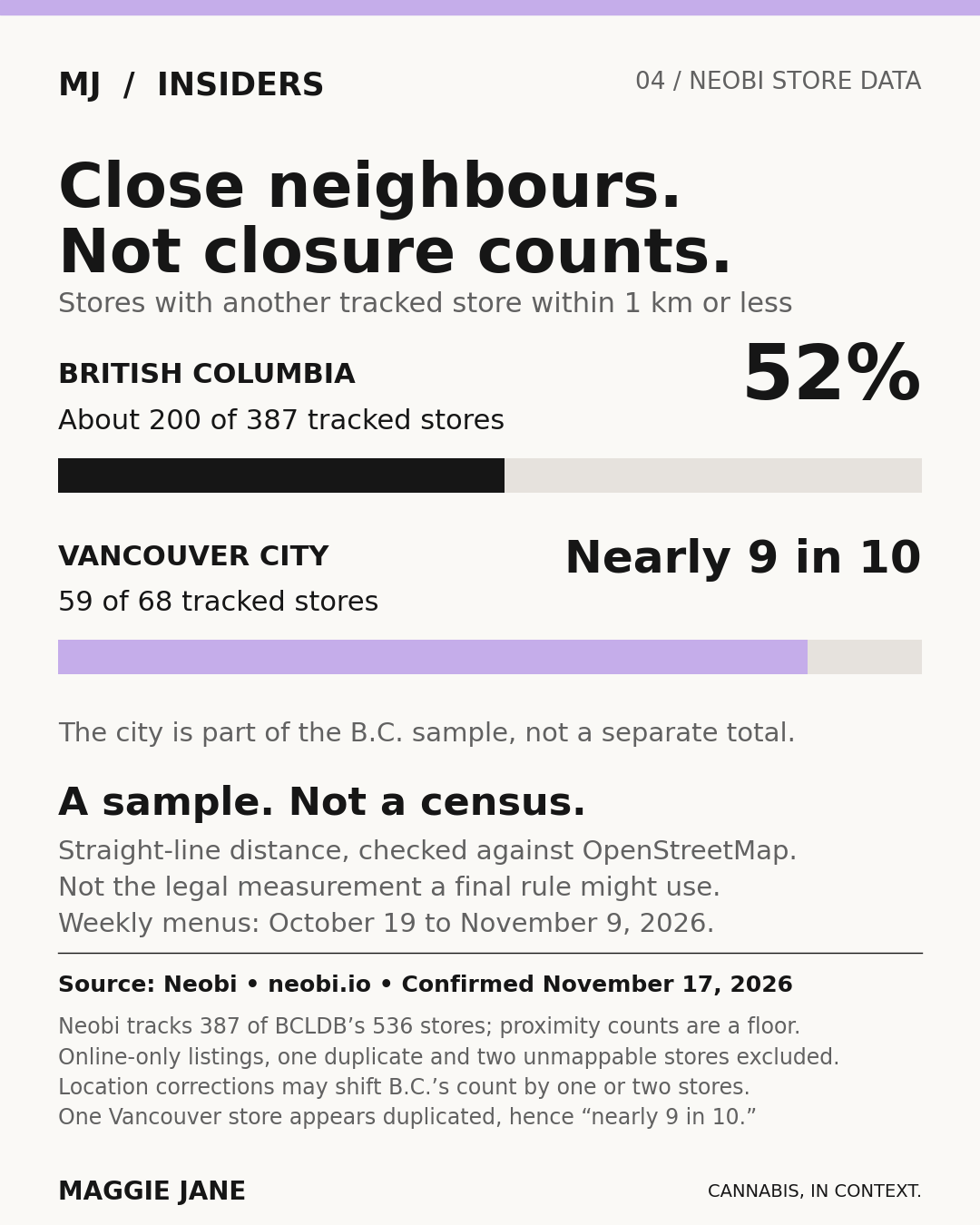
The analysis describes proximity within that sample. It does not count stores that would close or establish how a final rule would measure distance. The rule is still a proposal and the public consultation summary does not explain how existing locations would be treated. That is the clarification operators need before turning a map into a business decision. UBCM consultation summary
Dates worth putting in the calendar
Ontario’s Bill 143 includes proposed enforcement changes for unlicensed shops. Written comments are due November 18 at 6 p.m. Eastern. If you are contributing, give the committee a concrete example rather than another general statement that enforcement matters. Ontario hearings
In B.C., vape producers covered by the recycling rule should check responsibility for their stewardship plan ahead of December 15. Call2Recycle’s consultation was scheduled for November 18 at noon B.C. time. Confirm the applicable scope and requirements rather than assuming another company in the supply chain has it covered. B.C. supplier notice · Consultation
Health Canada’s cannabis tracking consultation closed November 10. Continue reporting under existing requirements. A closed consultation does not itself change the rules. Health Canada
What we would check first
Cost one direct-delivery route properly. Pull the vape reorder report. Separate the revenue forecast by channel and write down what the proposed proximity rule still leaves unanswered. There is enough useful work in this week’s news without treating every announcement as a reason to rebuild the business.
Thank you to Michael Colbourne and Neobi for the menu and store-proximity analysis.